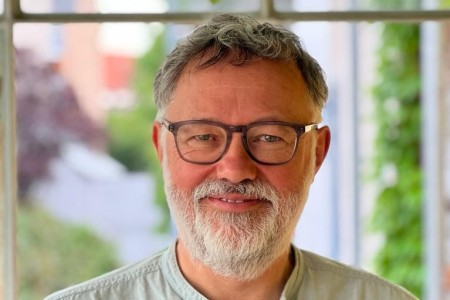
Interview with Alexander Marschall
Alexander Marschall, founder, shareholder and managing director of vinocentral GmbH, Darmstadt
Where does your passion for wine come from, and what makes it so special to you?
It all began in 1993 with Italian specialities, and wine was naturally part of that from the very start. Over the years, this has developed into a genuine passion. What makes wine special to me is that no other product tells the story of its origins quite like it does: of the soil, the climate, tradition and the people who make it.
What is your favourite European wine?
It varies, but at the moment I’m a big fan of the Furmint from Verus in Slovenian Styria. Three winemakers who are friends founded the winery in 2007, and their Furmint is juicy, round and harmonious, with a delicate minerality. Even the name is fitting: Verus means ‘true’, and that is exactly what I expect from a wine.
Do you have a favourite wine-growing region?
Southern Dalmatia, where I have deep personal roots. When you know a region not just as a holidaymaker, you taste the wine differently. For me, the Plavac Mali from Pelješac and the Pošip from Korčula are a slice of life in a glass, and we stock both at vinocentral.
Which region is an insider’s tip or on the rise?
I’m keeping a close eye on Greece, Portugal and Eastern Europe. These regions boast indigenous grape varieties and winemakers with a real pioneering spirit, who are still virtually unknown over here. We deliberately stock dozens of wines from these countries because there’s still so much to discover in Europe.
What is the secret to your success?
We think from the guest’s perspective, not in terms of sales channels. Here, you can have an espresso in the morning, enjoy any bottle from our range in the evening, and experience wine at tastings and events. At the same time, customers from all over Europe order from our online shop. Our selection is based on quality rather than trends; personalised advice remains at the heart of what we do; and our diverse team is the soul of the business.
What challenges are you currently facing?
Wine consumption is falling, people are drinking more consciously, and younger target groups want to be approached differently. Online retail and AI are changing how people gather information and shop, whilst rising costs and a shortage of skilled labour are further challenges. It is important to us to operate responsibly: for example, by using a cargo bike and running a wine cellar without heating or cooling, as well as a socially inclusive business.
To what extent can EUROVINO offer solutions?
Particularly in a market undergoing such rapid change, there is a need for spaces for direct exchange. At a curated trade fair, you can sample and compare a great deal in a short space of time and speak to producers, because the initial selection has already been carefully curated. It also highlights new developments, from emerging wine regions to non-alcoholic wines.
What appeals to you about the role on the advisory board?
I bring over 30 years’ practical experience from specialist retail, the hospitality sector and online retail - in other words, precisely the perspective of the buyers for whom the trade fair is designed. I’d like to contribute my perspective on quality and provenance, as well as on exciting new discoveries. And I’d like to strengthen dialogue within the industry, because nobody can solve the big questions of our time on their own.
Why is the focus on the German-speaking market important?
The German-speaking market is one of Europe’s most important wine markets, with its own preferences and structures. A trade fair that focuses specifically on this brings together producers and retailers who are truly well-suited to one another. And Karlsruhe is situated right in the middle of the major German wine-growing regions - the distances could hardly be any shorter.
What does EUROVINO mean to you personally?
To be honest, we’ve never been big fans of massive trade fairs; we prefer smaller events and visiting winemakers on site. EUROVINO has precisely this quality: it’s manageable, curated and entirely focused on wine. You have time for genuine conversations and go home with new ideas rather than sore feet.